Small crappie baits can produce big catches if you use the best fishing techniques. Learn about 5 proven approaches.
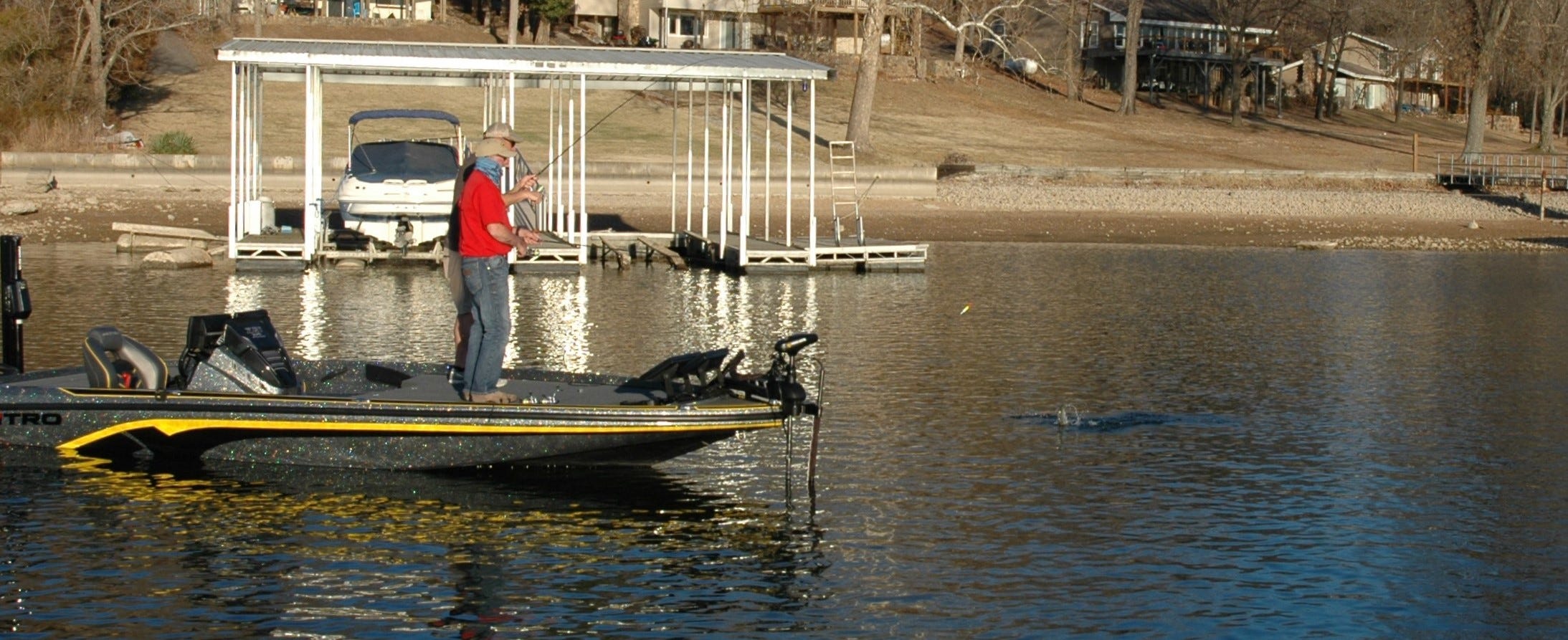
“Something’s changed,” avid crappie angler Gary Rowe said, as he watched another fish on his Garmin LiveScope follow and then shy away from the jig at the end of his line. Just minutes before, the Oklahoma angler and Bobby Garland pro staffer was telling me this was the very spot where he and his son had quickly finished out their summer crappie limits the day before. The crappie weren’t cooperating today, though.
Having witnessed the same scenario at two other places where Rowe had caught them the day before, I politely suggested “let’s go explore some new areas.” After all, I knew this long-time friend had more than 1400 crappie fishing waypoints on Fort Gibson Lake – from which he lives just a block away.
“Okay, but humor me for just a second,” he said, turning to grab another rod. No longer than it took for his new offering to reach the 10-foot cover, Rowe was snapping a hookset and lifting a crappie from the same brush we’d been fishing for the past 20 minutes. Grinning, but saying nothing, he admired the 10-incher and then gently tossed it back. On each of his next three drops, the results were the same: a keeper crappie coming aboard.
Learn about different crappie rigs that allow you to present soft-plastic crappie baits more effectively for a broad range of situations.
In my opinion, the most classic of all crappie rigs – a soft-plastic crappie bait rigged on a small jighead – is the most fish-catching tool on the planet. Think about it. The combo is so little that fish of all sizes, from tiny to giant, can and do eat it. We all have stories about catching – or at least hooking into – monsters of some kind on a crappie bait.
The crappie jig looks like food, most often imitating a prey fish or insect. Today’s technology allows for precision-made, multi-cavity aluminum molds that feature intricate design shapes and features. The result is a realistic forage match that appeals to most gamefish. Sometimes subtlety tempts the most. The perfect example is the teasing action of the flexible, straight tail on a Bobby Garland Baby Shad. Conversely, a bait with a crazy amount of tail action, like the heavy-thumping Bobby Garland Stroll’R, might drive attention.
A crappie jighead is the standard business partner for a host of soft-plastic crappie baits. However, at times, other crappie rigs, including some you might not consider, provide the best means for presenting these baits. Let’s look at ways that non-traditional weighting approaches can boost your crappie catching success.
If you ever wonder what color crappie lures to buy or tie on, this guide to top colors and picks from crappie fishing experts will aid future decisions.
Okay, here’s the dilemma. A buddy calls unexpectedly and says he’s just decided to go crappie fishing. He’ll be picking you up in 30 minutes. The problem’s not the short time, (most of us probably could be out the door in 15), but rather the fact that he instructed you to bring only one color of crappie fishing lure.
That’s it. ONE color! No additional details are given. You don’t know if the water is clear or muddy, or something in between. And you can’t help but wonder if the destination will have white crappie, black crappie or both.
Understanding how crappie see things can help you make better lure selections and more effective presentations.
Reprinted with permission from In-Fisherman, the following excerpt about a crappie’s vision is taken from “Making Sense of Crappie Behavior,” an article written by Steve Quinn that appeared in the In-Fisherman 2015 Panfish Guide. We feel the timeless knowledge is a real eye-opener as to just how much crappie depend on sight for their feeding preferences, and therefore wanted to share the information again here.
(Text is exactly as it appears in the article. Photos courtesy of Bobby Garland Crappie Baits)
Making Sense of Crappie Behavior
Biological Keys to Triggering a Hot Bite
By Steve Quinn
Watching crappies move under water demonstrates their cautious deliberate style that makes, at times, for the fastest fishing imaginable. Other times they leave us baffled, wondering where they went or why they won’t bite.
Learn how expert crappie angler recognize the end of the spawn and how they adjust fishing approaches to continue catching spring crappie.
Cold fronts have shut down the shallow-water action on certain days, but most of the time, the crappie have been aggressive and attacked nearly anything thrown near their spawning beds. However, in the last few days the shallow-water bite has been tapering off, so you begin to wonder whether those fish you were catching along the spawning banks have been wiped out by fishing pressure or if the crappie have quit spawning.
Crappie guides and tournament veterans look for certain signs to determine if the spawn is entering its final stage.
Spring brings some of the year’s best opportunities for crappie fishing from the bank. Learn how to find and catch more crappie with a shoreline approach.
Everything looked perfect for bank fishing for crappie. The water color, bottom makeup, bank slope and cover mix all seemed ideal. The only thing missing was the crappie – at least any crappie that were willing to bite!
So, I began walking and casting, targeting scattered laydowns and stumps and making “search” casts between pieces of cover. Maybe 100 yards from my starting point the chunk rock along the lake’s edge turned to gravel and the bank got a little flatter. Scattered wood a modest cast’s distance from the shore seemed shallow but looked inviting for crappie fishing.
I clipped a spring float about 18 inches from my jig and cast tight to the first piece of wood. The float barely got upright before racing sideways, and I set the hook into a solid crappie. Repeating that cast produced the same result. Twice. The next piece of wood produced a repeat performance. I had found the right set up, setting the stage a fun day of bank fishing for crappie.
Different crappie fishing jigheads vary in many ways. We’ll examine important variables and tell how to choose the best jighead for every situation.
Glitzy soft-plastic crappie lures, with their fish-catching designs and colorful identities, get the glory in crappie fishing while the journeyman jighead silently tags along but does the heavy lifting – literally.
Success draws attention, and that is certainly the case when a splashing livewell or basket full of slabs echoes loudly and proudly across the boat ramp or dock at the end of an outing. All ears within hearing distance strain to hear the answer when someone dares ask, “Whatcha catch ‘em on?”
No doubt it’s more fun to hear a response with bait names like Slab Hunt’Rs and Slab Slay’Rs, and colors called Purple Monkey and Electric Chicken, than, “a 1/8-ounce white jighead with a size 1 hook.” Yet, jigheads need love too, for without them most crappie baits are little more than tacklebox candy.
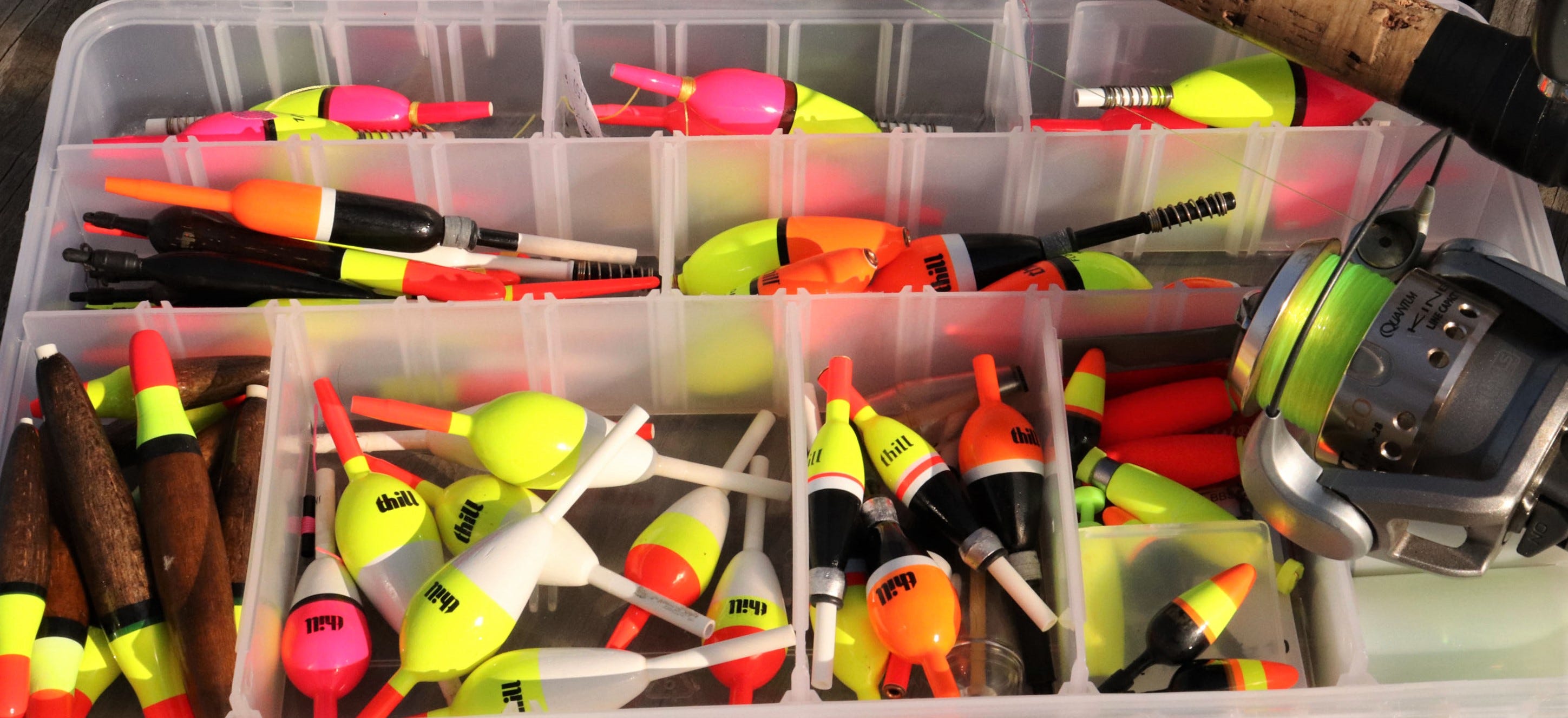
Floats or bobbers come in many sizes and shapes and in fixed and slip-float configurations. This float fishing guide removes the mystery.
The mention of bobber fishing commonly calls up a mental image of an idyllic pond setting with a youngster watching a cork on the water’s surface. However, floats (commonly called bobbers) have come a long way. While the basic mechanics remain the same, many of today’s floats are designed to be more bite-sensitive, are created for specific purposes and are integral to many anglers’ arsenals.
Depending on the intended angling technique, a float could be part the presentation for any freshwater fish. Bluegills, crappie, smallmouth bass, white bass, trout, bowfin and catfish are among the fish I have targeted with a float. The line-up of Thill Floats encompass a variety of floating bite-indicators for still-water, current, and long-distance casting.
Pre-spawn crappie fishing delivers some of the best action of the year, and the fish’s behavior lends itself ideally to fishing and jig beneath a bobber.
A childhood thrill returns to Terry Blankenship every spring when pre-spawn crappie fishing heats up at Lake of the Ozarks. The Missouri guide and tournament angler recalls how excited he would get watching a bobber zip underwater when he was a kid, bobber fishing for crappie. Blankenship continues to experience that excitement today, albeit with a more sophisticated bobber setup.
“We all love our bobbers,” Blankenship said. “Bobber fishing for crappie is a little bit like topwater fishing for bass. It’s just something, if you have done it a bunch, you are kind of focused on that bobber, and when you are fishing with artificial lures instead of minnows you have to be pretty observant and pretty quick with it. It kind of keeps you a little tense if you feel like you are in a position to get a bite. It winds up being pretty much like the excitement of a topwater bite because of the way crappie sometimes hit it and knock it to where it goes down so fast, but other times they just barely nudge it or turn it sideways. That’s why you really have to pay attention to it.”
Learn about the Mayfly, an innovative new crappie bait to be released by Bobby Garland this summer.
Great fishing secrets are hard to keep, and word has gotten out that a new Bobby Garland bait – The Mayfly – is on schedule to “hatch” in July. So rather than letting rumors confuse the facts, here are full details about this cool creation in advance of its summer availability.
The Mayfly is a 2.25-inch insect-profile design that stays true to Bobby Garland’s reputation of product innovation specific to crappie fishing. This new soft-plastic bait is loaded with features appealing to multiple senses crappie rely on for feeding.
Learning more about spring crappie behavior related to the spawn can help you catch more fish.
The crappie spawn has major impact on fish behavior during spring and opens some of the year’s best opportunities for catching crappie from shallow water. Most anglers know that much. Where questions arise are with details about things like when the fish move up, how long they hang around, the types of areas they favor, and, consequently, how all that impacts spring crappie fishing strategies.
With such questions in mind, we turned to Josh Johnston, Fisheries Supervisor for the Oklahoma Department of Wildlife Resources, and Gary Dollahon, brand manager for Bobby Garland Crappie Baits. Significantly, both also speak from the perspective of being avid crappie anglers.
Understanding the purpose behind various crappie bait profiles and how designs affect bait movement can help you choose the best crappie fishing bait for every situation.
The sea of crappie baits available today can make lure selection a daunting task. Aside from all the brands, shapes and body styles, there are the colors … lots and lots of colors.
Having been responsible for the Bobby Garland Crappie Baits lineup for the past 16 years, I’ve seen countless blank stares and fielded scores of frustrated questions from tackle show attendees across the country, with many asking, “Where do I start?”
Although I don’t know the background for every crappie lure out there, I do for the development of every Bobby Garland product. Perhaps you’ll find some of the insight shared here helpful in making bait selections for your style of crappie fishing.